Why anglers go
- Sight fishing for bonefish on foot or from a skiff, year-round
- Permit on the same flats, typically best from April through July
- Islands with very different flats, from Andros to Long Island and Acklins
- Islands such as Cat Island suited to do-it-yourself wading
- Wahoo, tuna and mahi offshore, with billfish released
When to fish Bahamas Out Islands
What is commonly targeted month by month. Notes under the chart explain the regional detail.
| Species | Jan | Feb | Mar | Apr | May | Jun | Jul | Aug | Sep | Oct | Nov | Dec |
|---|---|---|---|---|---|---|---|---|---|---|---|---|
| Bonefish | Yes | Yes | Peak | Peak | Yes | Yes | Yes | Yes | Yes | Yes | Yes | Yes |
| Permit | No | No | Yes | Peak | Peak | Peak | Peak | Yes | Yes | Yes | No | No |
| Tarpon | No | No | No | Yes | Yes | Yes | Yes | Yes | No | No | No | No |
| Mahi-mahi | Yes | Yes | Yes | Peak | Yes | Yes | Yes | No | No | No | No | Yes |
| Wahoo | Peak | Peak | Peak | Yes | No | No | No | No | No | Yes | Peak | Peak |
| Tuna | No | No | Peak | Peak | Peak | Peak | Peak | Yes | No | No | No | No |
"Yes" = commonly targeted in a typical year; "Peak" = the months sources single out. Broad patterns only: runs, weather and openings vary every year, and regulations can close a fishery. Check the agency before you book.
- Bonefish
- Fished on the flats all year throughout the Out Islands, with March and April rated the strongest months. Bonefish spawn offshore from about late October through April, gathering in large schools before they go.
- Permit
- A flats fish that builds through March and is typically best from April through July, tapering into fall. Bimini's back-bay flats hold permit as well as bonefish.
- Tarpon
- Found on the flats mainly from April through August, rated good at best in May and June. Treat tarpon as a possible bonus on a bonefish trip rather than the main target.
- Mahi-mahi
- Dolphin (mahi-mahi) are an offshore catch from winter into midsummer, typically best in April. They are one of the fish offshore boats keep for the table.
- Wahoo
- A fall and winter fish, caught offshore and along the reef edge, typically best from November through March.
- Tuna
- Yellowfin (called Allison tuna locally) are typically best from March through May, and blackfin in June and July. Bluefin pass through in late spring.
Why go
The Out Islands are where most anglers go to learn what bonefishing is about. The islands are surrounded by miles of shallow flats and seagrass, and bonefish live there in such numbers that feeding schools stir up visible clouds of sand. On many flats you get repeated shots at fish in a day, which is not true of every bonefish destination.
That does not make it easy. Bonefish are wary, hunted by barracuda, and spook at a splash or a shadow. The trip rewards patience, good polarized glasses and a guide who can see fish long before you can.
It suits fly anglers above all, from first-timers to people who plan their year around the flats. It also works for a mixed group: a few islands have dedicated fishing lodges, and most have hotels where a partner who does not fish can spend the day on the beach. The tradeoffs are cost and logistics. Most islands need a second, smaller flight to reach.
The fishing
Bonefish
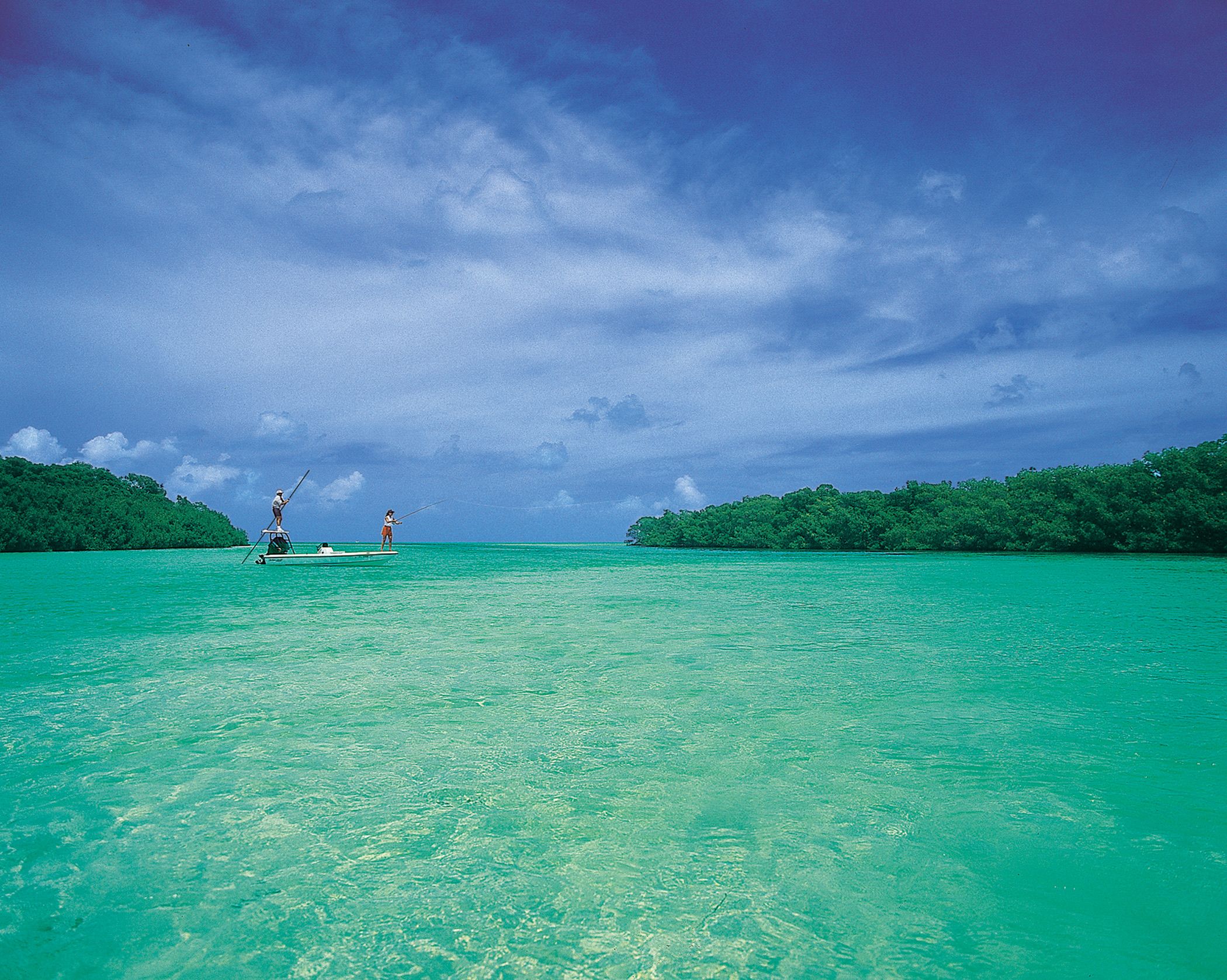
Bonefish are the reason to come. You either wade the flats on foot or stand on the casting deck of a shallow-water skiff while a guide poles you along. The fish feed on crabs, clams and shrimp in water often only inches deep, and the game is spotting them, making a quiet cast, and holding on when they run.
They are fished all year in the Out Islands. Spring, especially March and April, is usually rated the best stretch, with good fishing through the rest of the year. Bonefish spawn offshore at night, near full and new moons, from about late October through April. Before they go, they gather in pre-spawning schools that can hold thousands of fish. Outside of spawning, most bonefish stay close to home: in tagging studies, more than three-quarters of recaptured fish were caught within a kilometer of where they were tagged.
Permit and tarpon
Permit share the flats and are the harder fish to fool. They build from March, are typically best from April through July, and taper off into fall. Bimini’s back-bay flats are one place known for both bonefish and permit.
Tarpon show on the flats mainly from April through August, but they are rated good at best, not excellent. Treat a tarpon shot as a bonus on a bonefish trip. If tarpon are your main goal, the Florida Keys are a stronger bet.
Offshore
The islands sit beside deep water, and boats troll for blue and white marlin, sailfish, wahoo, tuna and dolphin. Billfish are released, while wahoo, tuna and mahi-mahi can go to the table. Wahoo are a fall and winter fish, best from November through March. Yellowfin, known locally as Allison tuna, peak from March through May, and blackfin in June and July. Mahi run from winter into midsummer and are typically best in April.
Known offshore spots include Cuban Hole off Cat Cay south of Bimini, James Point off Harbour Island, the south end of Eleuthera, the Hump and leeside drop-off at San Salvador, Tartar Bank off Cat Island, Southeast Point off Rum Cay, the northern tip of Long Island, and Diana Bank near Crooked Island and Acklins. Reef fishing for amberjack, grouper and snapper is best from spring through early fall.
Where to fish
Andros
Andros is cut by bights and creeks, and its bonefishing is the most varied in the islands. In the north, guides fish the Joulter Cays. In South Andros, they run to Deep Creek and Little Creek, and to the west side and southern tip, where much of the water sees few anglers. National parks now protect large parts of the Andros flats.
The Abacos
Guides on Great Abaco fish the Marls, a large area of flats on the island’s west side, and Cherokee Sound on the east. Hurricane Dorian badly damaged mangroves on Abaco and Grand Bahama, and Bonefish & Tarpon Trust’s conservation plan for the Bahamas calls for replanting them.
The Exumas
Most flats on Great Exuma are separated from the island by channels of shallow, clear water, so a boat helps. George Town is the main airport and the easiest base.
Long Island
Long Island has thousands of acres of flats with little fishing pressure. Many are five to ten minutes by boat from the island’s hotels, which keeps travel time short.
Bimini, Eleuthera and the quieter islands
Bimini’s back bay holds bonefish and permit, along with grouper and snapper. North Eleuthera and its creek system are good bonefish water. Cat Island is known for unpressured fishing for anglers who want to wade on their own, and Acklins, one of the quietest islands, has large areas of flats and experienced local guides.
Charters and guides
The flats lodge model
The classic Out Islands trip is a dedicated bonefish lodge. You stay at the lodge, eat there, and head out each morning with a professional guide on a skiff. Lodges are built for serious fly anglers, and the guide’s eyes are a big part of what you pay for. Lodge owners and guides are allowed to buy your flats licence before you arrive, so ask whether that is included.
Before you book, ask how many anglers share a boat, which flats the lodge fishes and how far the runs are, what tackle is provided, and how the lodge adjusts for wind and weather days. Our guide to comparing fishing lodges has a full checklist.
DIY wading vs guided
You can fish the flats on your own with a licence, and no guide is required when wading. Cat Island and Long Island are good DIY choices, with hotel-based access to lightly fished water. Rent a car or hire a taxi to reach the flats, and ask locally about access.
A guide is still worth it for at least the first day or two. Spotting bonefish takes practice, and guides know which flats fish on which tide. Flats rules also cover when Bahamian guides and Bahamian boats are required, so check the current rules if you plan to fish from a boat with a friend. See our guided vs DIY fishing guide for the general tradeoffs.
Catch and release
Bonefish, permit and tarpon on the flats are catch-and-release fish, and billfish caught offshore must be released unless they are part of an approved tournament. The Bahamas bonefish fishery is also big business: Bonefish & Tarpon Trust puts its annual economic impact at more than $169 million, much of it in Out Island communities.
Bonefish & Tarpon Trust has studied bonefish in the Bahamas for years. Its tagging work has found pre-spawning sites on several islands, and that data helped create national parks protecting two of those sites on Grand Bahama and one on Abaco. The group also helped establish protected bonefish conservation zones in the Bahamas. The main threats today are habitat loss from dredging, development and storm damage.
How you handle a fish makes a real difference. A bonefish lifted out of the water for more than ten seconds is about six times less likely to survive. Good habits:
- Use a dehooking tool so the fish can stay in the water.
- If you lift it, use clean, wet hands, with no gloves or sunscreen, and keep it over the water.
- Decide on photos and have the camera ready before you lift the fish.
- Watch for barracuda and other predators, and do not release a tired fish where they are waiting.
Where to stay
Pick the island first, then the base. Lodges suit anglers who want everything handled. Hotels and small resorts work better if you plan to wade on your own or travel with people who do not fish. Long Island’s flats are close to its hotels, and the Abacos, the Exumas and North Eleuthera have ferries and water taxis for getting between cays. Car rentals on the smaller islands are often one- or two-car operations, so ask your hotel to arrange one.
Trip costs
Flights are the first big cost. Unless your city has a direct flight to an island airport, expect to connect through Nassau or Florida. Guided skiff days or a full lodge package make up most of the rest. A DIY wading trip from a hotel is the lower-cost way to fish. Your flats licence is a small extra cost; the government licence page lists current fees. We do not quote lodge or guide prices, since they vary by island, season and package.
Getting there and around
Each Out Island has its own airport or airstrips. Andros is served at San Andros, Fresh Creek, Mangrove Cay and Congo Town, with flights from Nassau and, to several of these, from Fort Lauderdale. Abaco flights land at Marsh Harbour and Treasure Cay. George Town in the Exumas has flights from Nassau, Miami, Fort Lauderdale, Charlotte, Atlanta and Toronto. Long Island is reached through Stella Maris from Nassau and Fort Lauderdale. Schedules change by season, so confirm with the airline. Local airports sometimes close for repairs, too.
On the islands, taxis are the easy option and drivers often know where the fishing is. Rent a car if you plan to move around a lot.
Weather is the other planning factor. The Atlantic hurricane season runs from June 1 to November 30, peaking around September 10, with most activity between mid-August and mid-October. Spring trips avoid it entirely. For summer and fall dates, book flexible flights and lodging, consider travel insurance, and watch the National Hurricane Center. Our trip safety and weather guide and traveling with fishing gear cover the rest.
Licenses and rules
Anyone fishing the flats needs a personal flats fishing licence from the Department of Marine Resources. You can apply online or on paper at the department or a local Administrator’s Office. Flats guides need their own licence and a Ministry of Tourism certification.
Boats are a separate matter. A foreign-owned boat needs a sport fishing permit, issued by Customs at the port of entry or by the Department of Marine Resources afterward, and charter and party boats fall into a different permit category from private boats. If you are visiting on your own boat, sort this out before you fish; if you book a Bahamian charter or lodge, ask what they cover.
Rules on catch limits, protected species and the flats change. Check the Department of Marine Resources before every trip, and see our fishing licenses guide for general background.
Frequently asked questions
When is the best time to bonefish in the Bahamas Out Islands?
Bonefish are on the flats all year, and March and April are usually rated the strongest months. Spring also lines up well with permit, which typically peak from April into July. Late summer and fall overlap the hurricane season, so book those months with more flexibility.
Do I need a fishing licence to bonefish in the Bahamas?
Yes. Anglers fishing the flats need a personal flats fishing licence from the Department of Marine Resources, which you can apply for online. Lodge owners and guides are allowed to buy the licence for you before you arrive. Check the government's licence page for current requirements before you go.
Can I bonefish in the Bahamas without a guide?
Yes, wading on your own is allowed with a flats licence, and islands such as Cat Island and Long Island are known for lightly fished flats. A guide still helps a lot with spotting fish and reading tides, especially on your first days. If you fish from a boat with more than one angler, check the current guide rules first.
Which Out Island is best for bonefishing?
It depends on the trip you want. Andros has the most varied water, from the Joulter Cays to the remote west side. The Abacos, the Exumas and Long Island have lodges and good hotel options nearby, while Cat Island and Acklins suit anglers who want quiet, lightly fished flats.
Are bonefish kept in the Bahamas?
Bonefish, permit and tarpon on the flats are fished catch-and-release. Bonefish & Tarpon Trust research found that a bonefish held out of the water for more than ten seconds is far less likely to survive, so keep it wet and release it quickly. Check current rules with the Department of Marine Resources.
When is hurricane season in the Bahamas?
The Atlantic hurricane season runs from June 1 to November 30, and most storms form between mid-August and mid-October. Spring trips avoid it entirely. For summer and fall dates, watch the National Hurricane Center and choose flexible bookings.
Sources and fact-checking (14)
Facts checked against these sources on October 23, 2026. Seasons, rules and businesses change; confirm with the official source before you travel. How we research.
- Bonefishing, The Out Islands of the Bahamas (myoutislands.com)
- Bonefishing Lodges, The Out Islands of the Bahamas (myoutislands.com)
- Gamefish Chart, The Out Islands of the Bahamas (myoutislands.com)
- Deep Sea Fishing, The Out Islands of the Bahamas (myoutislands.com)
- Fishing Regulations, The Out Islands of the Bahamas (myoutislands.com)
- Transportation Options to the Out Islands, The Out Islands of the Bahamas (myoutislands.com)
- Getting Around in the Out Islands, The Out Islands of the Bahamas (myoutislands.com)
- Flat (Fly) Fishing Licence, Applying for a, Government of The Bahamas (bahamas.gov.bs)
- Sport Fishing Permit, Government of The Bahamas (bahamas.gov.bs)
- Bahamas Moves to Protect Fly Fishing Industry, Bahamas Ministry of Tourism (tourismtoday.com)
- Bahamas Bonefish Conservation Action Plan 2021, Bonefish & Tarpon Trust (bonefishtarpontrust.org)
- BTT Accomplishments, Bonefish & Tarpon Trust (bonefishtarpontrust.org)
- Bonefish Handling, Bonefish & Tarpon Trust (bonefishtarpontrust.org)
- Tropical Cyclone Climatology, National Hurricane Center (nhc.noaa.gov)