Why anglers go
- Kenai River: all five Pacific salmon species plus rainbow trout and Dolly Varden
- Russian River sockeye, fly-fishing-only for most of the year
- Halibut and salmon charters out of Homer and Seward
- Dozens of public access sites along the Kenai River
- Reachable by road from Anchorage in roughly two to five hours
When to fish Kenai Peninsula
What is commonly targeted month by month. Notes under the chart explain the regional detail.
| Species | Jan | Feb | Mar | Apr | May | Jun | Jul | Aug | Sep | Oct | Nov | Dec |
|---|---|---|---|---|---|---|---|---|---|---|---|---|
| Salmon | No | No | No | No | Yes | Yes | Peak | Yes | Yes | Yes | No | No |
| Trout | Yes | Yes | Yes | Yes | Yes | Yes | Yes | Yes | Peak | Peak | Yes | Yes |
| Halibut | No | No | No | No | Yes | Yes | Yes | Yes | Yes | No | No | No |
| Rockfish | No | No | No | No | Yes | Yes | Yes | Yes | Yes | No | No | No |
"Yes" = commonly targeted in a typical year; "Peak" = the months sources single out. Broad patterns only: runs, weather and openings vary every year, and regulations can close a fishery. Check the agency before you book.
- Salmon
- Covers king (Chinook), sockeye (red), coho (silver) and pink salmon. On the Kenai River, late-run sockeye typically peak in late July, coho run from late July into October, and pinks are far more numerous in even-numbered years. Kenai River kings have been closed to fishing in recent seasons; check emergency orders.
- Trout
- Rainbow trout on the Kenai and Russian rivers from mid-June through April, with fall often the best time as trout feed on salmon eggs and carcasses. Dolly Varden, a char, are typically fished mid-May through October.
- Halibut
- Charters run from Homer, Seward and the beach launch at Anchor Point. Out of Seward, good catches typically start in May as halibut move shallower and continue through September.
- Rockfish
- Black rockfish and other species are commonly caught on the same trips as halibut over rocky structure. Every boat sport fishing in Alaska salt water must carry a deepwater release device.
Why go
The Kenai Peninsula is the easiest way into serious Alaska fishing. It sits south of Anchorage on the road system, so you can rent a car, drive a few hours, and be standing in a salmon river the same day. The Kenai River alone can produce all five Pacific salmon species along with resident rainbow trout and Dolly Varden, and Homer and Seward add halibut, rockfish and saltwater salmon.
It suits a wide range of anglers. Bank fishers can work sockeye from public boardwalks in Soldotna. Fly anglers can drift the upper Kenai for trout. Families can fish the Homer Spit lagoon. And if you want someone else to handle every detail, there are guided day trips and all-inclusive lodges.
The tradeoff is company. Peak sockeye season draws a lot of people, and the Russian River’s shoulder-to-shoulder fishing has its own nickname. Pick your dates and spots with that in mind.
The fishing
Salmon drive the calendar here. Use these as broad patterns from ADF&G’s published run timing, not guarantees. Runs vary in size and timing every year, and the state adjusts fisheries in season by emergency order.
- Sockeye (red) salmon: The main summer event. The Kenai’s late run typically enters the lower river in early July, peaks in late July, and is mostly done by late August, with most fish arriving in the last two weeks of July. The Russian River has an early run that usually arrives by mid-June and a larger late run from mid-July. The Kasilof sees sockeye from June through August.
- Coho (silver) salmon: Arrive on the Kenai in late July, with more fish from August into early October. The Russian River confluence sees coho from about late July or early August through September.
- Pink (humpy) salmon: Present from mid-July through August, and far more abundant in even-numbered years because of their two-year life cycle. Most Kenai pinks are caught downstream of the Sterling Highway bridge in Soldotna.
- King (Chinook) salmon: The Kenai is famous for big kings, including the 97-pound, 4-ounce sport record caught in 1985, and historically had an early run (mid-May through June) and a late run (July). In recent seasons, though, ADF&G has closed the Kenai to king fishing entirely, catch-and-release included, by preseason emergency order. The Kasilof has had limited hatchery-king opportunity under its own emergency rules. Do not plan a king trip without checking ADF&G’s emergency orders.
- Rainbow trout: Many Kenai rainbows live in the river year-round, and most are released. ADF&G lists trout fishing from mid-June through April, and fall is often best, when trout feed on salmon eggs and carcasses.
- Dolly Varden: Both resident and sea-run fish are present, typically fished mid-May through October. The middle and upper river are preferred areas.
In salt water, halibut fishing out of Seward typically runs from May, as fish move up from deeper wintering grounds, through September. Most halibut caught near Seward run 10 to 35 pounds, though much larger fish are caught. Rockfish and lingcod are common bycatch and targets on the same trips. For more on the fish themselves, see our salmon, trout and halibut pages.
Where to fish
Kenai River
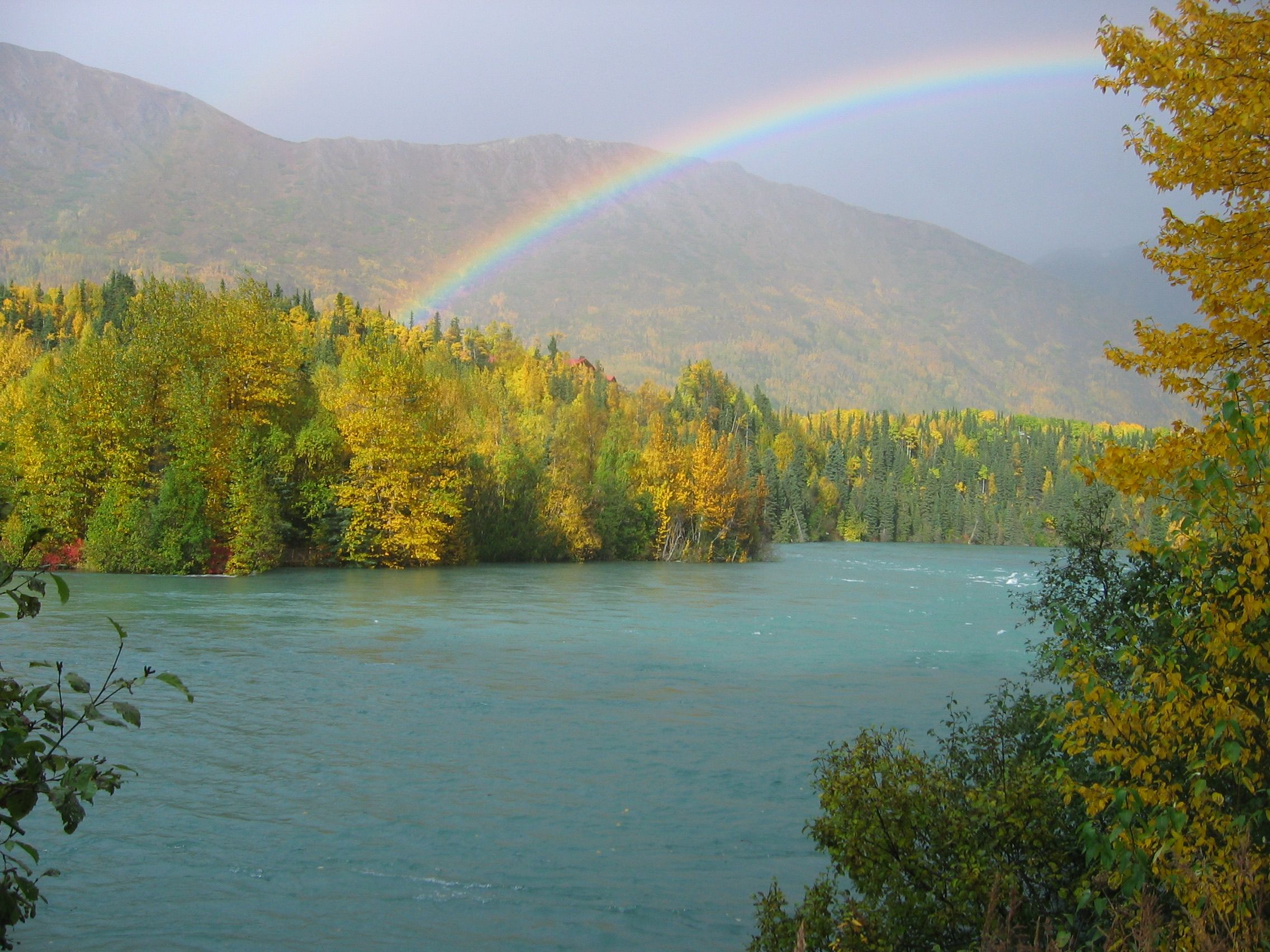
The Kenai flows 82 miles from Kenai Lake at Cooper Landing to Cook Inlet near the city of Kenai. Glacial silt gives it the milky blue-green color. ADF&G divides it into three sections:
- Upper Kenai (Kenai Lake to Skilak Lake, about 17 miles): includes a canyon section with whitewater not recommended for novice boaters. Popular for guided drift trips for trout and sockeye.
- Middle Kenai (Skilak Lake to Naptowne Rapids, about 19.5 miles): best reached by boat.
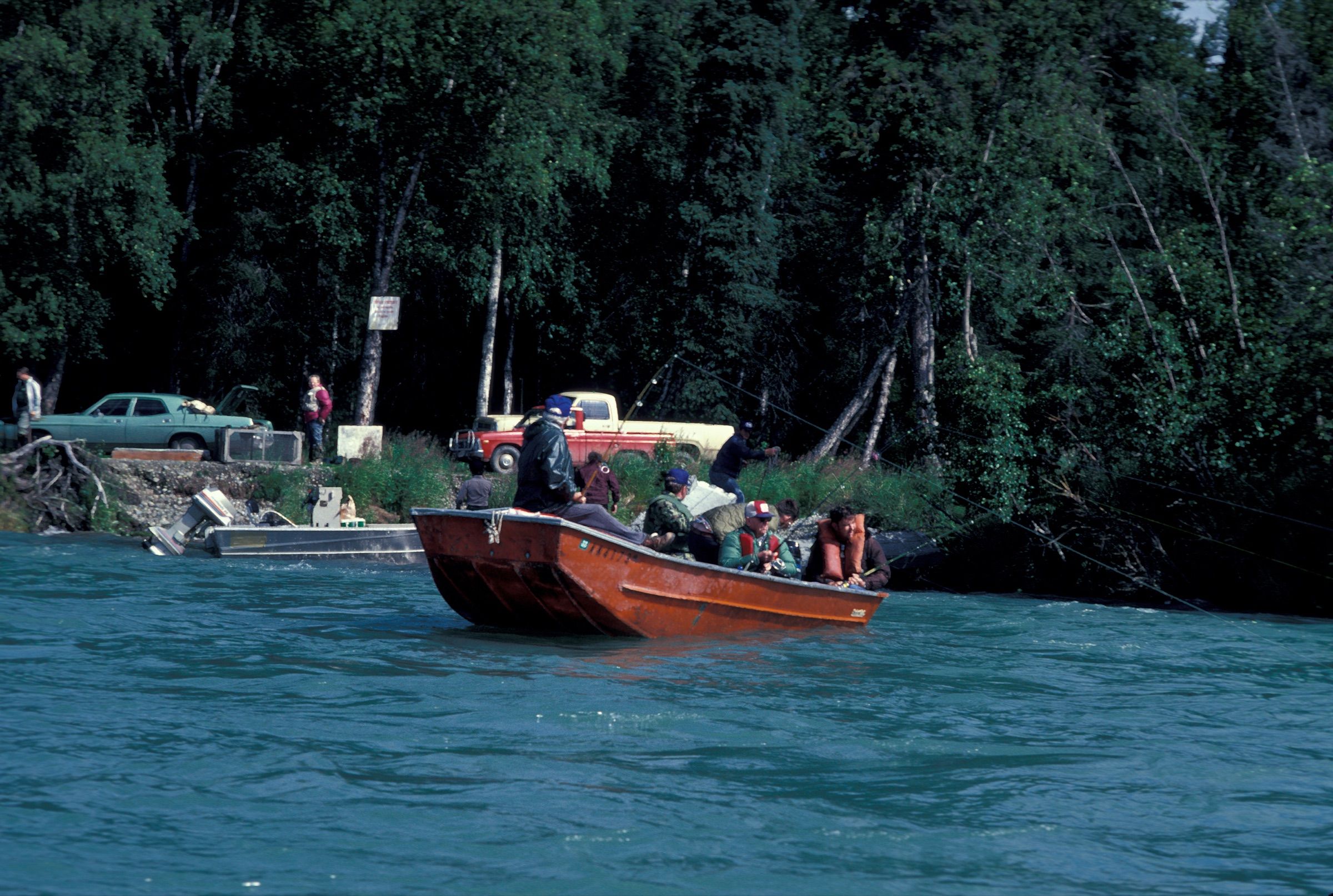
- Lower Kenai (Soldotna’s Sterling Highway bridge to the mouth, about 21 miles): gentler water, with the last 12 miles tidal. This is where most powerboat fishing for salmon happens.
Public access is extensive. ADF&G lists more than two dozen shoreline access sites, from beaches at the mouth to Soldotna’s city parks, state recreation sites like Morgan’s Landing and Izaak Walton, and refuge and Forest Service sites near Cooper Landing. Soldotna has free public fish walks at Centennial Park Campground, Swiftwater Park Campground, Soldotna Creek Park and behind the visitor center. Some sites charge fees.
Sockeye travel close to shore, so most sockeye fishing happens from the bank. New anglers often wade or cast too far out while the fish swim behind them.
Russian River
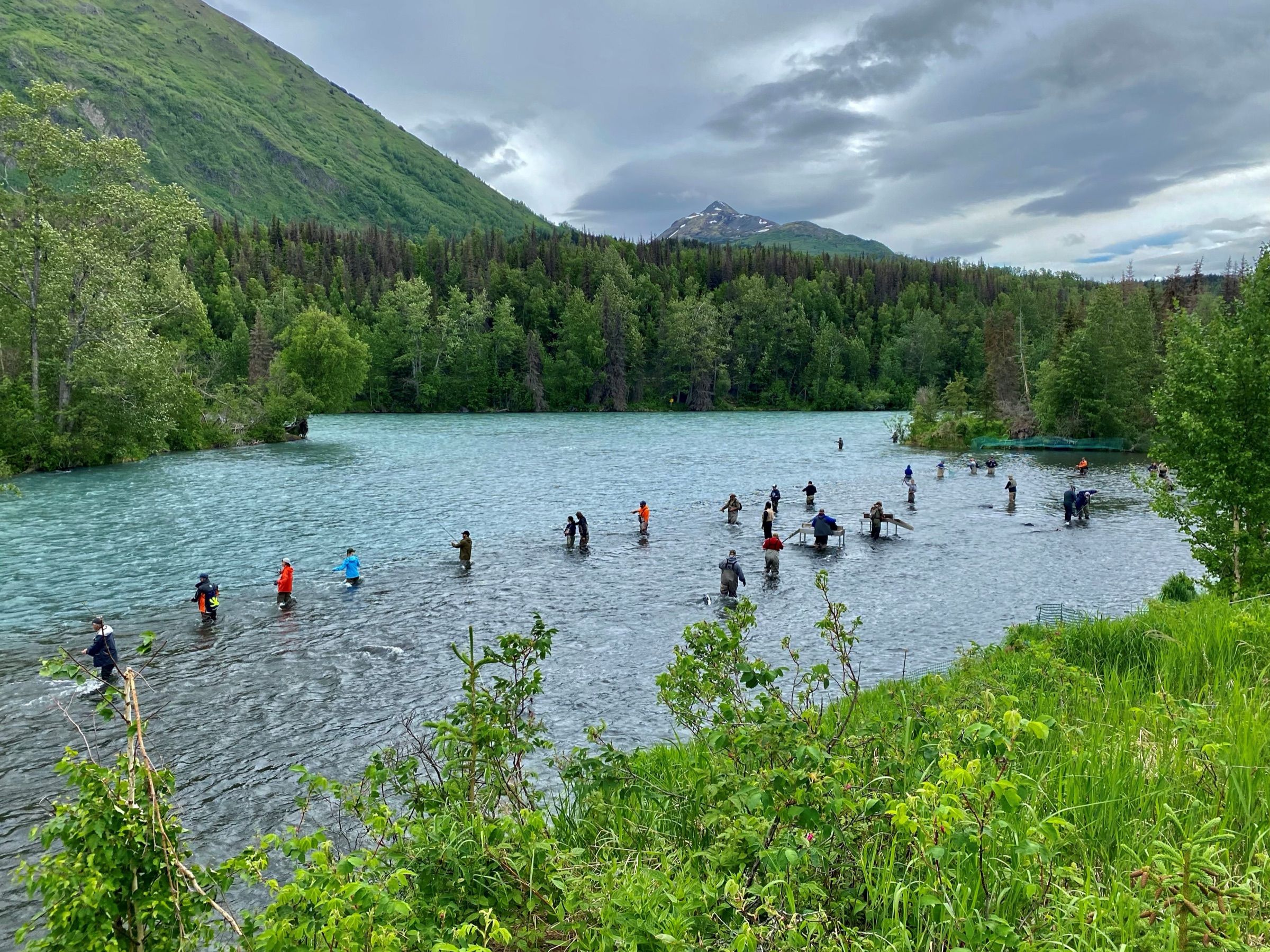
This clear tributary joins the upper Kenai near Cooper Landing, about 110 miles from Anchorage. Most fishing happens in the lower three miles of the Russian and about a mile of the Kenai below the confluence. For most of the year it is fly-fishing-only water, though you can use a spinning rod as long as the hook is a fly. In summer it is known for “combat fishing,” with anglers packed close together. Bears also fish these banks.
The Forest Service’s Russian River Campground has 83 sites and the Kenai National Wildlife Refuge runs Sportsman’s Landing, with a foot ferry across the Kenai. Both fill quickly in season. Rainbow trout fishing in spring and late fall is a much quieter experience here.
Kasilof River
South of Soldotna, the Kasilof sees sockeye from June through August, coho from late July through September, and catch-and-release steelhead in spring and fall. Its king fishery has been managed for hatchery fish only under recent emergency orders, with part of the lower river closed in early summer. Check current rules before you go.
Homer and Kachemak Bay
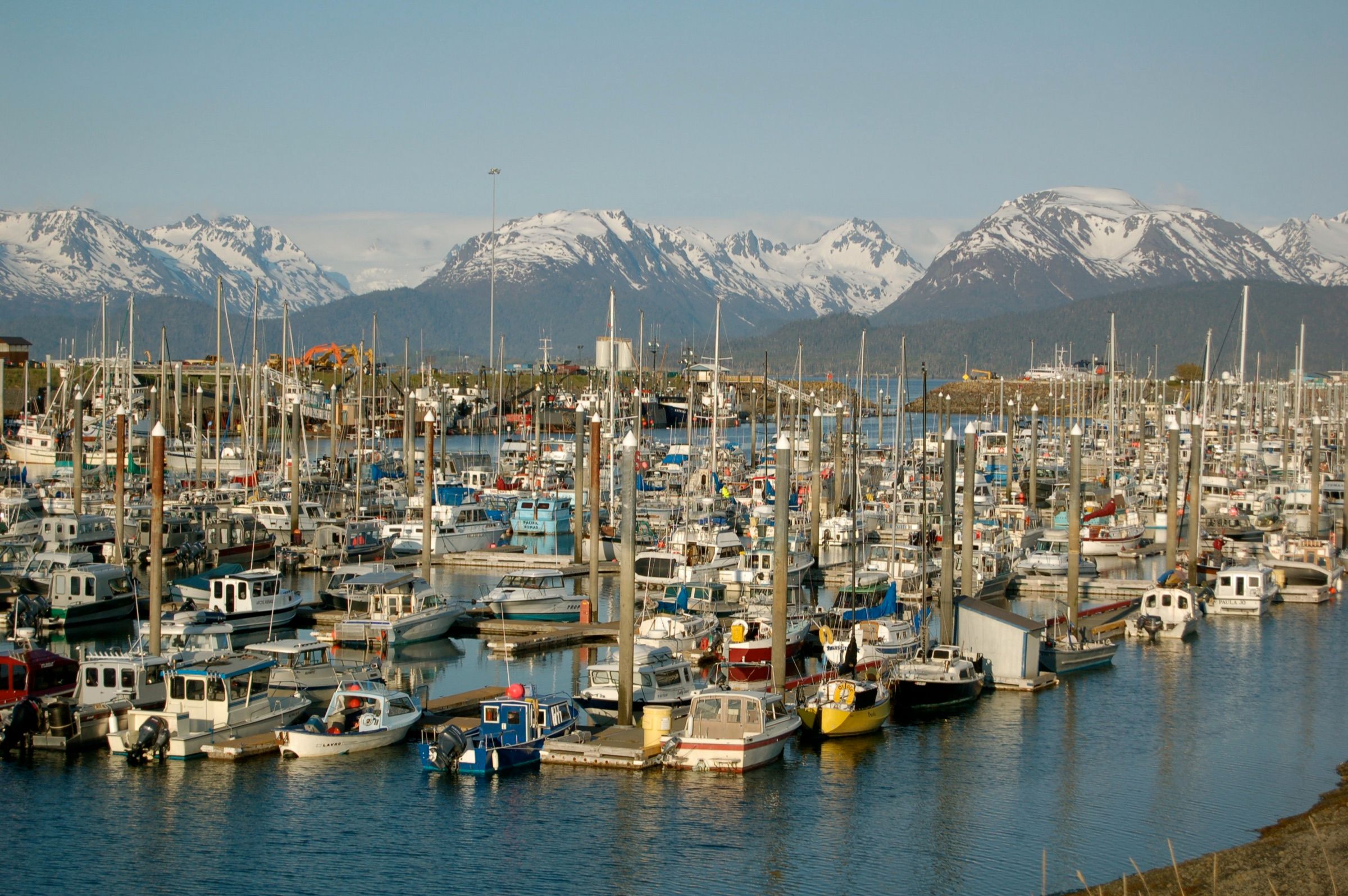
Homer sits at the end of the Sterling Highway on Kachemak Bay and bills itself as the Halibut Fishing Capital of the World. Charters run up to 50 miles or more into Kachemak Bay and Lower Cook Inlet. Expect long days: most halibut trips leave early and last about 12 hours. Charters also target salmon, rockfish and lingcod.
The 4.5-mile Homer Spit has the Nick Dudiak Fishing Lagoon, stocked with king and coho salmon for shore anglers. Stocked kings there typically show in mid-May, peak in mid-June, and are gone by early July, while coho arrive around mid-July. Dolly Varden fishing along the spit is typically best from mid-May to mid-July.
Seward and Resurrection Bay
Seward sits at the head of Resurrection Bay, 127 miles from Anchorage by highway. Most anglers fish salt water for silver, king and pink salmon, halibut, lingcod and rockfish. Many Seward charters run well beyond the bay, into Prince William Sound waters around Port Bainbridge and Montague Island.
Silvers begin entering the outer bay in the last week of June, with fishing continuing into mid-September. Shore anglers do best from late August into September near the Lowell Creek waterfall, the Seward Lagoon outfall and the small boat harbor. Resurrection Bay kings are mostly hatchery fish returning from mid-May through June. The Seward Silver Salmon Derby runs in mid-August.
Deep Creek, Ninilchik and Anchor Point
The lower peninsula’s small streams (Anchor River, Deep Creek and Ninilchik River) have historically seen kings in late May and June, coho from early August into September, Dolly Varden, and catch-and-release steelhead in fall. As with every stream on the peninsula, check emergency orders before you plan around kings. Anchor Point has no harbor; from May through September, charters launch from the beach by tractor to fish Cook Inlet for halibut and salmon.
Charters and guides
On the Kenai, guided anglers catch fish more efficiently, and ADF&G suggests a local guide can improve your odds, especially for boat-based fishing. Guides drift the upper river for trout and sockeye, run powerboats on the lower river for silvers, and many offer coho trips for beginners or anglers without gear. Kenai River guides must register with ADF&G and hold a commercial permit from the Alaska Department of Natural Resources; the Kenai River Center keeps a list of permitted guides.
Halibut charters typically provide rods, tackle and bait, and clients usually bring their own food and coolers. If you plan to keep halibut on a charter in Southcentral Alaska, you now also need a federal charter halibut stamp for each day of fishing; most guides handle the purchase, and some build it into the trip price. Many Seward operators can process, freeze and ship your catch.
Questions to ask: what species and water the trip actually targets this week, how many anglers per boat, whether processing is included, and what happens if an emergency order closes the fishery. Our guided vs DIY fishing guide covers the decision in more depth.
Where to stay
- Soldotna: The hub for the lower Kenai, with hotels, inns, fishing lodges, B&Bs, campgrounds and RV parks, several right on the river.
- Cooper Landing: Best for the upper Kenai and Russian River, with lodges, B&Bs, cabins and campgrounds.
- Homer: Base for halibut, with B&Bs, hotels, cabins, vacation rentals and campgrounds on the Spit.
- Seward: Base for Resurrection Bay, with downtown and harbor hotels and quieter cabins and inns at Lowell Point. Downtown lodging books up early.
For full-service options, see our guide to Alaska fishing lodges, which covers road-system lodges like those on the Kenai.
Beyond fishing
Seward is the gateway to Kenai Fjords National Park, with glacier and wildlife cruises and the road to Exit Glacier. Homer has kayaking and trails in Kachemak Bay State Park and bear-viewing flights. The Kenai National Wildlife Refuge covers about 2 million acres, and its visitor center in Soldotna has salmon exhibits and short trails. Cooper Landing has rafting from gentle floats to Class III whitewater in the Kenai Canyon.
Getting there and around
Fly into Anchorage and drive. The Seward Highway runs south along Turnagain Arm, and the Sterling Highway branches west through Cooper Landing and Soldotna to Homer. Approximate distances from Anchorage: the Russian River about 110 miles (2 to 3 hours), Seward 127 miles, Soldotna about 140 miles, and Homer about 220 miles (about 4.5 hours). The Alaska Railroad also runs to Seward in summer, and Homer has scheduled regional flights from Anchorage. A car gives you the most flexibility to follow the fish between rivers and ports.
Licenses and rules
ADF&G sells sport fishing licenses and king salmon stamps online. Nonresidents 16 and older need a license, and anyone fishing for kings needs a stamp, catch-and-release included. Kenai-area rules are in the Southcentral regulations booklet, and ADF&G’s emergency orders override it, sometimes on short notice. Halibut rules come from NOAA Fisheries, with separate limits for charter and unguided anglers. Alaska also requires every boat sport fishing in salt water to carry a deepwater release device for rockfish.
Rules change, often in season. Check the Southcentral regulations, the emergency orders and NOAA’s halibut page before every trip. See our fishing licenses and traveling with fishing gear guides for general planning, and our Kenai salmon run timing guide for choosing dates.
Fishing-friendly places to stay
Editorial picks from each property's own website. No one paid to be listed here.
Hotel · Soldotna
Kenai River Lodge
A family-owned riverfront hotel in Soldotna with more than 400 feet of guest-only bank fishing on the Kenai River, stairs down to the water, and fish-cleaning tables.
- Fish cleaning
Access: drive-to, on Riverside Drive in Soldotna
Amenities as the property lists them (checked 2026-10-23). Confirm details, rates and availability directly.
Fishing lodge · Cooper Landing
Kenai Riverside Lodge
A lodge on the upper Kenai River in Cooper Landing, run by Alaska Wildland Adventures, with multi-day guided fishing packages for salmon, rainbow trout and Dolly Varden, plus Resurrection Bay trips.
- Guided fishing packages
- Meals included
Season: Fishing packages run from early June into late September.
Access: drive-to, Milepost 50.1 of the Sterling Highway, about two hours south of Anchorage
Amenities as the property lists them (checked 2026-10-23). Confirm details, rates and availability directly.
Fishing lodge · Soldotna
Soldotna B&B Trophy Lodge
A 12-room lodge on the Kenai River in Soldotna with a private dock, guided freshwater and saltwater fishing packages, and charters for salmon, trout, steelhead and halibut out of Homer and Seward.
- Guided fishing packages
- Dock or boat slips
Season: The lodge's fishing page lists target windows by species, from halibut starting in May to silver salmon into October.
Access: drive-to, on the Kenai River in Soldotna
Amenities as the property lists them (checked 2026-10-23). Confirm details, rates and availability directly.
Frequently asked questions
When is the best time to fish the Kenai Peninsula for salmon?
It depends on the species. Late-run sockeye on the Kenai River typically enter in early July and peak in the last two weeks of July, while coho run from late July into October. Russian River early-run sockeye usually arrive by mid-June. Runs vary every year, so check ADF&G fish counts and emergency orders as your dates approach.
Can you fish for king salmon on the Kenai River?
Not in recent seasons. ADF&G closed the Kenai River to king salmon fishing, including catch-and-release, for both the early and late runs by emergency order in 2025 and 2026. Kenai king openings are decided year by year, so check ADF&G's emergency orders before planning a king trip.
What is combat fishing on the Russian River?
It is the local name for the shoulder-to-shoulder sockeye fishing near the Russian River Campground and the Kenai confluence in summer. Expect crowds, learn the etiquette (land fish quickly, cast in rhythm with your neighbors), and watch for bears, which fish the same banks.
Do I need a guide on the Kenai River?
No. Sockeye travel close to shore and most sockeye fishing is done from the bank, and there are many public access sites. A guide helps most with boat-based fishing such as coho and trout drifts. Kenai River guides must register with ADF&G and hold a state Department of Natural Resources permit.
Where do you go for halibut on the Kenai Peninsula?
Homer, Seward and Anchor Point. Homer bills itself as the Halibut Fishing Capital of the World and has a large charter fleet, Seward boats often run into the Gulf and Prince William Sound waters, and Anchor Point charters launch from the beach by tractor from May through September.
How far is the Kenai River from Anchorage?
The Russian River confluence on the upper Kenai is about 110 miles, or 2 to 3 hours, from Anchorage. Soldotna on the lower river is about 140 miles away, and Homer is about 220 miles, around four and a half hours.
Sources and fact-checking (22)
Facts checked against these sources on October 23, 2026. Seasons, rules and businesses change; confirm with the official source before you travel. How we research.
- ADF&G: Fishing the Kenai River (adfg.alaska.gov)
- ADF&G: Kenai, Soldotna and Homer run timing (adfg.alaska.gov)
- ADF&G: Fishing the Russian River (adfg.alaska.gov)
- ADF&G: Kachemak Bay sport fishing (adfg.alaska.gov)
- ADF&G: Seward and North Gulf Coast sport fishing (adfg.alaska.gov)
- ADF&G Emergency Order 2-KS-1-8-26 (Kenai early-run kings closed) (adfg.alaska.gov)
- ADF&G Emergency Order 2-KS-1-7-26 (Kenai late-run kings closed) (adfg.alaska.gov)
- ADF&G Emergency Order 2-KS-1-3-25 (Kenai late-run kings closed) (adfg.alaska.gov)
- ADF&G Emergency Order 2-KS-1-18-26 (Kasilof River kings) (adfg.alaska.gov)
- ADF&G: Emergency orders and press releases (adfg.alaska.gov)
- ADF&G: Fish counts (adfg.alaska.gov)
- ADF&G: Sport fishing licenses (adfg.alaska.gov)
- NOAA Fisheries: Sport halibut fishing in Alaska (fisheries.noaa.gov)
- NOAA Fisheries: New requirements for halibut charter fishing in Alaska (fisheries.noaa.gov)
- Travel Alaska: Kenai Peninsula (travelalaska.com)
- Travel Alaska: Soldotna (travelalaska.com)
- Travel Alaska: Homer (travelalaska.com)
- Travel Alaska: Seward (travelalaska.com)
- Travel Alaska: Cooper Landing (travelalaska.com)
- Travel Alaska: Anchor Point (travelalaska.com)
- Travel Alaska: Road trips (travelalaska.com)
- Travel Alaska: Fishing lodges (travelalaska.com)