Check current conditions and rules
Official sources for real-time information. Conditions change daily; these pages are the authority, not this guide.
- NWS: Ice safety guidelinesIce thickness guidelines and when to stay off the iceLast checked Oct 24, 2026
- Michigan DNR: Ice safetyHow to judge ice, what to carry, and what to do if you go throughLast checked Oct 24, 2026
- Ohio DNR: Ice fishing safetySafety tips and what to do if you fall inLast checked Oct 24, 2026
- NOAA GLERL: Great Lakes ice coverCurrent and historical ice cover on the Great LakesLast checked Oct 24, 2026
- Michigan DNR: Weekly fishing reportRecent conditions from DNR staff around the stateLast checked Oct 24, 2026
Ice is never guaranteed. The Michigan DNR puts it plainly: your safety is your responsibility, and there is no reliable inch-thickness that makes ice safe. Official guidelines give you a starting point, but they assume new, clear ice, and real ice varies across a single lake and from one day to the next. Check it yourself, fish with others, and carry the gear to get yourself out.
Ice thickness guidelines
The National Weather Service publishes these guidelines for new, clear ice:
| Ice thickness (new, clear ice) | What the NWS guidelines say |
|---|---|
| Under 2 inches | Stay off |
| 2 to under 4 inches | Unsafe: below the 4-inch minimum for walking or ice fishing. Stay off |
| 4 inches or more | Walking, ice fishing, skating |
| At least 5 inches | Snowmobile or ATV |
| At least 8 to 12 inches | Car or small pickup |
| At least 12 to 15 inches | Medium-sized truck |
White or “snow” ice is only about half as strong as new, clear ice, and the NWS says to double these numbers on white ice. It also says to check with local officials, such as your state DNR, before heading out. The Minnesota DNR keeps detailed ice thickness guidelines as well.
Source: NWS: Ice safety, checked October 24, 2026.
Treat every number as a minimum under ideal conditions, not a promise. The Michigan DNR’s own guidance does not give a safe thickness at all, for good reason: a lake can have thick ice in one spot and thin ice a short walk away.
What weak ice looks like
The Michigan DNR’s guidance on reading ice:
- Clear ice with a bluish tint is strongest. Milky ice, formed from melted and refrozen snow, is weak.
- Stay off ice with slush on top. Slush ice is about half as strong as clear ice and means the ice is not freezing from the bottom.
- Snow-covered ice should always be considered unsafe. Snow insulates and slows freezing, and fresh snow can melt existing ice.
- Weather changes ice fast. A sudden cold front can open cracks within half a day. A warm spell can take several days to weaken ice, with thawing by day and refreezing at night. Ice also weakens with age.
- Watch the edges. If there is ice on the lake but open water at the shore, be extra careful.
- Avoid debris and de-icers. Logs or brush poking through the ice, and areas near dock bubblers or de-icers, are unsafe.
- Steer clear of dark spots and snow that looks discolored.
Source: Michigan DNR: Ice Safety, checked October 24, 2026.
The NWS adds: do not go out if you see cracks, holes or breaks in the ice, flowing water around the edges, under the surface or over the top, or ice that looks thawed and refrozen.
How to check the ice
Test as you go, not once at the shore. The Michigan DNR suggests checking thickness and quality with a spud, needle bar or auger. A spud is a long-shanked chisel: strike the ice ahead of you as you walk, and if it breaks through, turn back. Drill test holes and measure as you move farther out. Ask a local bait shop about conditions before you go, and do not rely on other people’s tracks.
Cracks and pressure ridges
Ice cracks as it shifts and can buckle into pressure ridges. Treat every crack and ridge as a hazard. DNR fishing reports flag them regularly. A 2018 report from Houghton Lake warned anglers not to drive across a pressure crack off the west launch, and a February 2026 report from Saginaw Bay said the cracks near Spoils Island were very active. Ask locally where the cracks are, cross only at known, tested crossings, and never drive across one.
Current, river mouths and inflows
The Michigan DNR notes that the stronger the current, the more likely the ice is to give way to open water. The NWS also warns against ice with flowing water around the edges, under the surface or on top. Give river mouths, inflows and outflows wide room.
Great Lakes bays and drifting ice
Great Lakes bays are some of the most popular ice fishing water in the region, and some of the most changeable. Bay ice can break loose from shore and drift with anglers on it. In February 2023 the Coast Guard airlifted 14 people from an ice floe on east Saginaw Bay at night, and Coast Guard crews had rescued 11 people from a floe off Sherwood Point in Green Bay earlier that day. The Coast Guard’s advice afterward: take precautions, not chances; dress for the water temperature; carry a VHF-FM radio or personal locator beacon; and tell someone where you are going and when you expect to return.
Source: U.S. Coast Guard: Coast Guard warns public of unsafe ice conditions, checked October 24, 2026.
DNR reports from Saginaw Bay in the 2026 season mentioned open pockets of water and thin spots on the east side. Before a Great Lakes trip, check the forecast for wind direction and speed, watch for offshore winds and rising temperatures, and know your way back to shore. See Saginaw Bay and our Lake Erie ice fishing guide.
Vehicles and snowmobiles
Driving on the ice is common on big northern lakes, but it is where the margin for error is smallest. Use the NWS guidelines above as a minimum for new, clear ice, double them for white ice, and keep testing as you go. Access changes quickly: a 2018 DNR report from Houghton Lake said vehicles could not go out from one launch because its ramp had buckled. Ask locally which launches and routes are in use, stay on established routes, and stay off ice near cracks, ridges and inflows. Snowmobiles and ATVs need less ice than cars, but they cover ground fast, so you can reach bad ice before you see it, especially at night.
Source: NWS: Ice safety, checked October 24, 2026.
Gear to carry
The Michigan DNR lists these tools:
- Spud or auger for testing ice
- Life jacket, worn
- Ice picks or claws, worn around your neck where you can reach them
- A two-way communication device that gets a signal, such as a charged phone in a waterproof case
- Ice cleats for traction
A throw rope lets a partner help you without walking onto the same weak ice. Pack dry clothes in a waterproof bag.
Source: Michigan DNR: Ice Safety, checked October 24, 2026.
If you go through
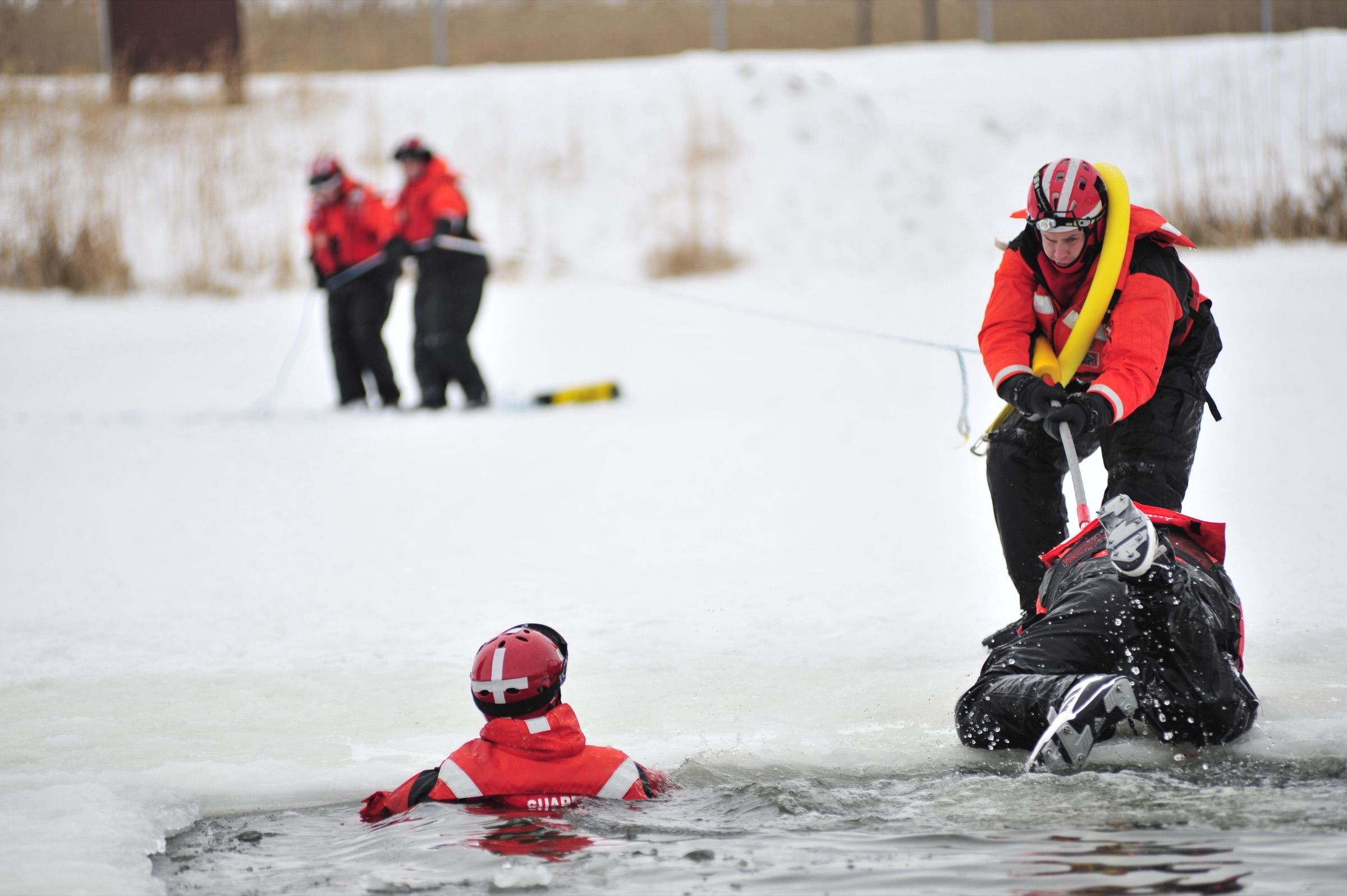
The Michigan DNR’s steps: stay as calm as you can and keep your winter clothes on, since they hold warmth rather than drag you down. Turn back toward the way you came, where the ice is most likely strongest. Dig your ice picks in and kick hard to slide forward onto the surface, then roll away from the hole to spread your weight. Get to shelter, change into dry clothes, and drink something warm without alcohol or caffeine. Call 911 if you feel disoriented, cannot stop shivering or have other signs of hypothermia.
Source: Michigan DNR: Ice Safety, checked October 24, 2026.
Why cold water is so dangerous
The National Center for Cold Water Safety explains the danger in stages. First comes cold shock: sudden immersion triggers involuntary gasping and hyperventilation, and a gasp underwater can drown you within moments. Next is physical incapacitation: as muscles and nerves cool, you lose strength and control, and in very cold water you can lose use of your hands in under a minute, which makes ice picks and self-rescue harder the longer you wait. Hypothermia comes later; it takes about 30 minutes for an average adult, even in near-freezing water. Act fast, and wear flotation so you stay up while you get out.
Go with others, and tell someone
The Michigan DNR’s basic rules: never fish alone, tell someone where you are going and when you expect to be back, always test the ice with a spud, carry a life jacket and ice picks, and bring a phone. Inside a heated shelter, the other hazard is carbon monoxide, covered in our shelters guide. For forecasts and general trip safety, see the fishing trip safety guide.
Destinations in this guide
Northern Michigan
The northwest Lower Peninsula pairs Lake Michigan charter ports like Ludington, Manistee, Frankfort and Grand Traverse Bay with salmon and steelhead rivers, inland lakes for bass, walleye and pike, and trout streams such as the Au Sable.
- Salmon
- Steelhead
- Lake trout
- Walleye
Minnesota Lake Country
Central and northern Minnesota's lake country, from the Brainerd Lakes to Mille Lacs and Leech Lake, built on walleye, pike, muskie, bass and panfish, the mid-May opener, family resorts with boat packages, and winter fish-house villages.
- Walleye
- Northern pike
- Muskie
- Bass

Lake Erie Western Basin
Ohio's western Lake Erie, from Port Clinton and Marblehead to the Bass Islands, Kelleys Island and Sandusky: spring walleye on the reefs and the Maumee and Sandusky river runs, yellow perch, island smallmouth, a large charter fleet and ferry-hop family trips.
- Walleye
- Panfish
- Bass
Frequently asked questions
How thick does ice need to be to walk on?
The National Weather Service guideline is 4 inches or more of new, clear ice for walking and ice fishing. Anything under 4 inches is not enough to walk on, and the NWS says to stay off ice under 2 inches entirely. White or snow ice is about half as strong, so double the guidelines. The Michigan DNR adds that no inch-thickness is reliably safe, so test the ice yourself as you go.
How thick does ice need to be to drive a truck on?
The National Weather Service guideline is at least 8 to 12 inches of ice for a car or small pickup and 12 to 15 inches for a medium-sized truck, based on new, clear ice. Thickness changes across a lake, so check locally and keep testing.
What should I carry for ice safety?
The Michigan DNR lists a spud or auger for testing ice, a life jacket, ice picks or claws, and a two-way communication device that gets a signal. Add ice cleats, a throw rope and dry clothes in a waterproof bag.
What should I do if I fall through the ice?
Stay as calm as you can and keep your winter clothes on. Turn back toward the way you came, dig your ice picks into the ice while kicking hard, slide forward onto the surface, then roll away from the hole. Get warm and dry right away, and call 911 if you feel disoriented or cannot stop shivering.
Sources and fact-checking (11)
Facts checked against these sources on October 24, 2026. Seasons, rules and businesses change; confirm with the official source before you travel. How we research.
- Ice Safety, Michigan DNR (michigan.gov)
- Ice fishing, Michigan DNR (michigan.gov)
- Ice Storms and ice recreation, National Weather Service (weather.gov)
- Coast Guard rescues 14 from ice floe in Saginaw Bay, WCMU Public Media (wcmu.org)
- Weekly Fishing Report: February 18, 2026, Michigan DNR (content.govdelivery.com)
- Weekly Fishing Report: January 28, 2026, Michigan DNR (content.govdelivery.com)
- Weekly Fishing Report: January 18, 2018, Michigan DNR (content.govdelivery.com)
- Cold Shock, National Center for Cold Water Safety (coldwatersafety.org)
- Physical Incapacitation, National Center for Cold Water Safety (coldwatersafety.org)
- Hypothermia, National Center for Cold Water Safety (coldwatersafety.org)
- U.S. Coast Guard warns public of unsafe ice conditions, U.S. Coast Guard (news.uscg.mil)